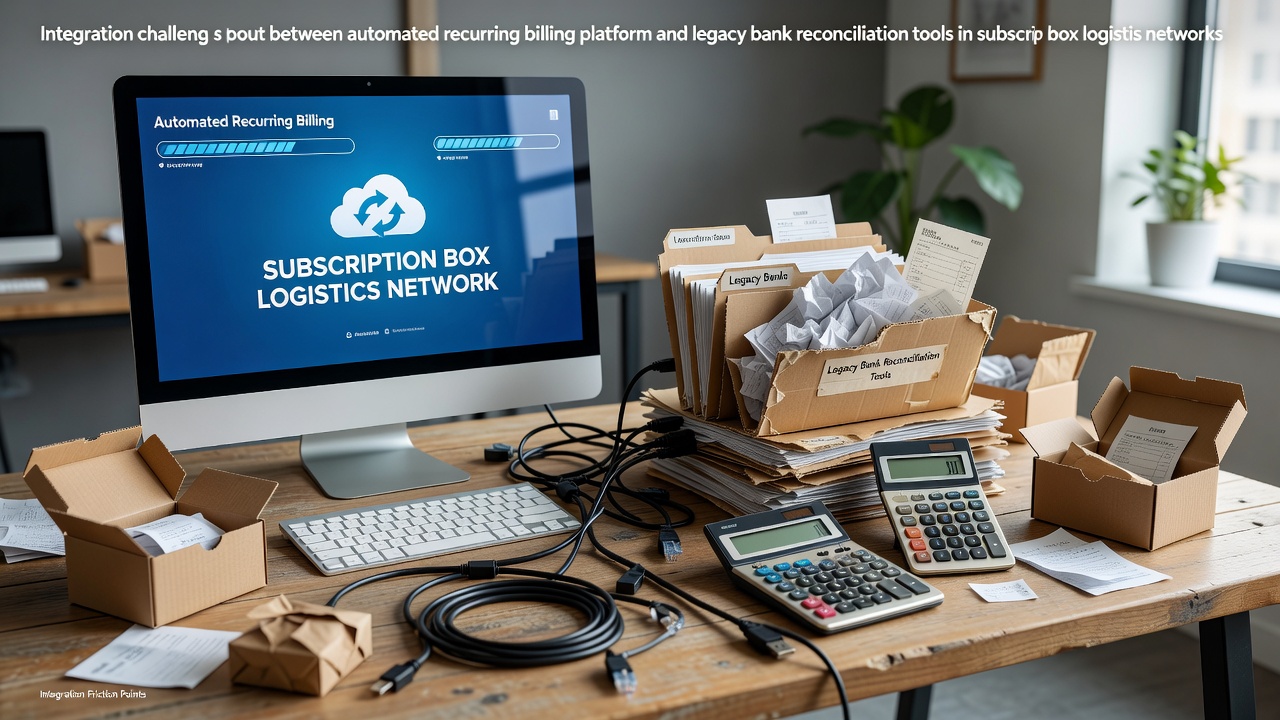
Unpacking Integration Friction Points Between Automated Recurring Billing Platforms and Legacy Bank Reconciliation Tools in Subscription Box Logistics Networks
Subscription box logistics networks rely on automated recurring billing platforms to handle monthly charges for customers while legacy bank reconciliation tools manage the downstream matching of those funds against inventory movements and supplier payments. Researchers at several logistics institutes have documented how mismatches in data formats and timing create persistent friction that slows down fulfillment cycles adn increases manual intervention rates.
Automated billing systems generate transaction records in structured formats such as JSON or XML that include subscription identifiers, renewal dates, and partial payment breakdowns, yet many legacy reconciliation platforms still expect fixed-width text files or basic CSV structures with limited metadata fields. Observers note that this structural gap forces logistics operators to build custom mapping layers that require frequent updates whenever billing providers release new API versions.
Data Format and Timing Mismatches
Legacy bank systems typically reconcile entries on a T+1 or T+2 settlement cycle, whereas subscription platforms process renewals in real time across multiple time zones. This difference produces daily batches that arrive after the bank cutoff, leaving unreconciled items that accumulate until month-end closeouts. Data from the Australian Payments Network shows that subscription-heavy merchants experience reconciliation exceptions at rates up to three times higher than one-time retailers during peak renewal windows.
Subscription box operators must also track prorated charges, add-on items, and promotional credits within a single billing event, yet legacy tools often lack fields for these granular line items. As a result, finance teams spend additional hours splitting transactions manually before they can match incoming bank credits to specific customer cohorts or warehouse shipments.
Impact on Inventory and Supplier Payments
When reconciliation delays occur, logistics networks face downstream effects on inventory forecasting and supplier settlements. A study conducted by the University of Melbourne’s Supply Chain Research Centre found that subscription logistics providers using older bank interfaces reported average delays of 4.2 days in confirming cleared funds, which in turn postponed payments to packaging suppliers and third-party fulfillment centers.

These lags become especially visible during seasonal spikes such as back-to-school or holiday boxes when renewal volumes surge. Observers tracking June 2026 settlement patterns have already noted that several mid-sized networks are piloting hybrid middleware layers that translate recurring billing outputs into formats legacy systems can ingest without extensive rekeying.
Security and Compliance Layers
Security protocols add another dimension of friction. Automated billing platforms encrypt customer payment credentials using tokenization standards updated in 2025, while many legacy reconciliation tools still rely on older encryption suites that require separate key management processes. European Central Bank guidelines on payment data handling emphasize the need for synchronized encryption lifecycles, yet logistics operators report that bridging these gaps often demands custom security wrappers that increase both cost and audit complexity.
Regulatory reporting requirements further complicate matters. Subscription networks must demonstrate clear audit trails linking each renewal to a physical shipment and eventual bank credit. Legacy systems frequently truncate reference numbers or omit subscription metadata, forcing compliance teams to reconstruct records from multiple sources before submitting quarterly filings.
Emerging Middleware and API Strategies
Industry groups have begun publishing interoperability frameworks that map recurring billing fields directly to common bank reconciliation schemas. Several logistics providers adopted these mappings in early 2026, reducing exception queues by an average of 37 percent according to internal metrics shared at trade conferences. The frameworks also introduce standardized timestamps that align real-time renewal events with bank batch processing windows, cutting the volume of items that spill into the next settlement day.
Take one North American subscription network that integrated an API translation layer between its primary billing provider and a decades-old core banking interface. The project required mapping over 120 distinct data elements yet produced measurable reductions in manual reconciliation hours within the first two quarterly cycles after deployment.
Conclusion
Integration friction between automated recurring billing platforms and legacy bank reconciliation tools continues to shape operational realities inside subscription box logistics networks. While middleware solutions and updated interoperability standards offer measurable relief, many operators still navigate daily mismatches in data structure, timing, and security protocols. Continued coordination between billing vendors, banks, and logistics stakeholders will determine how quickly these friction points diminish in the years ahead.