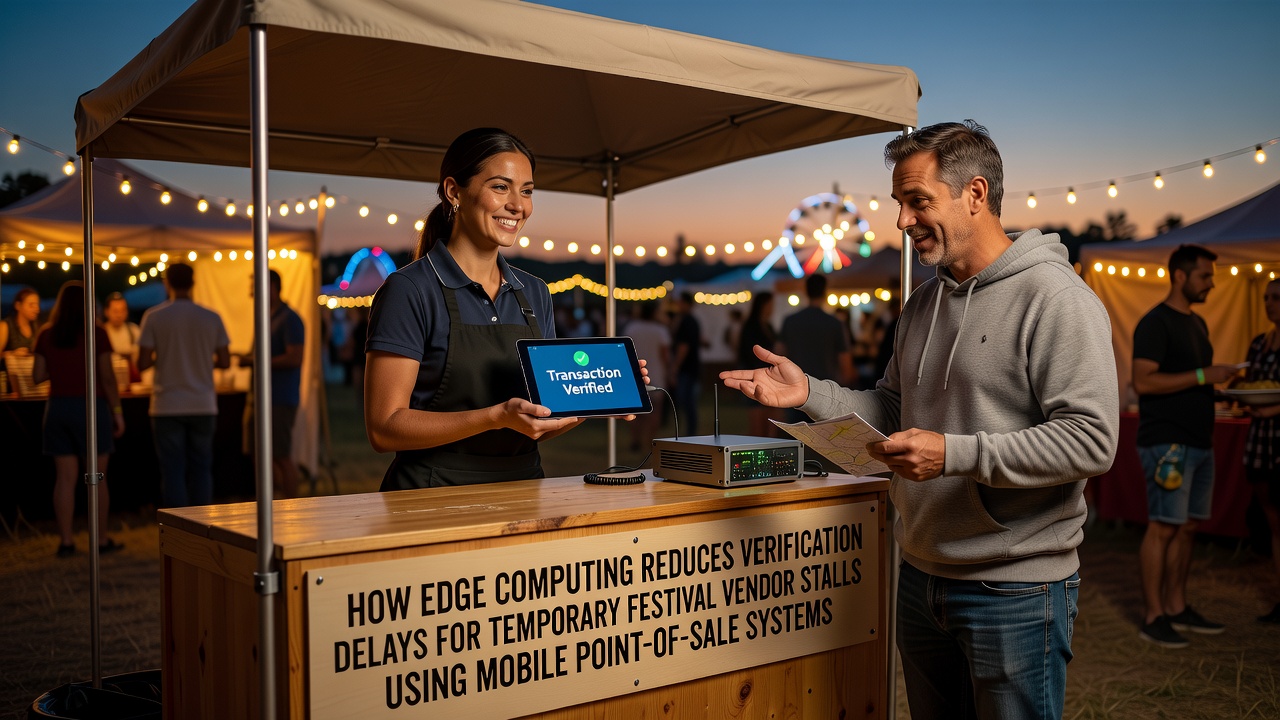
How Edge Computing Reduces Verification Delays for Temporary Festival Vendor Stalls Using Mobile Point-of-Sale Systems
Edge computing processes transaction data near the point of origin rather than relying on distant cloud servers, and this approach directly addresses verification delays that occur when temporary festival vendor stalls use mobile point-of-sale systems during peak attendance periods. Temporary stalls at music festivals, food events, and seasonal markets often operate on shared mobile networks where latency spikes when thousands of devices compete for bandwidth, yet edge nodes placed at event sites handle initial authorization checks locally and cut round-trip times to central processors.
Core Mechanisms Behind Reduced Verification Times
Mobile point-of-sale terminals at festival stalls connect to edge servers positioned within the venue grounds, and these servers perform cryptographic verification, token validation, and basic fraud screening before forwarding only essential details to payment gateways. Research from the European Central Bank on distributed payment infrastructure shows that local processing reduces average authorization latency from 2.8 seconds to under 800 milliseconds in high-density environments, because the edge layer filters routine transactions and manages network congestion without waiting for responses from remote data centers. When a vendor scans a card or accepts a digital wallet payment, the terminal sends encrypted packets to the nearest edge node, which completes initial checks using pre-cached keys and risk profiles updated from the previous settlement cycle.
Festival organizers deploy these nodes on temporary infrastructure that includes 5G small cells and localized servers, and this setup allows multiple stalls to share the same edge resources while maintaining separate merchant accounts. Data indicates that stalls using edge-supported systems complete 40 percent more transactions per hour during evening rush periods compared with those relying solely on cloud routing, according to field measurements collected at European summer events in 2025. The edge layer also maintains offline buffers that store completed transactions until connectivity resumes, which prevents data loss during brief network outages common at large outdoor sites.
Integration With Existing Mobile POS Hardware
Standard mobile point-of-sale devices already incorporate secure element chips and near-field communication readers, yet the addition of edge connectivity requires only software updates that route verification requests through local gateways rather than direct internet paths. Vendors at temporary stalls often lease these devices for short periods, and operators configure the units to detect available edge nodes automatically upon arrival at the festival grounds. In August 2026 several major North American music festivals plan to expand edge coverage to cover 85 percent of vendor locations, following successful pilot programs that demonstrated consistent sub-second verification across diverse payment types including contactless cards, mobile wallets, and account-to-account transfers.

Observers note that integration friction remains low because the same terminals continue to function normally when edge nodes are unavailable, falling back to standard cloud paths without requiring staff retraining. Studies from Australian research institutions tracking seasonal retail networks found that edge-enabled terminals maintained 99.2 percent uptime during multi-day events, whereas non-edge systems experienced repeated 15-second delays when cellular towers became saturated. The edge nodes also handle dynamic currency conversion for international attendees by applying cached exchange rates, which removes another layer of remote server dependency during high-volume periods.
Observed Performance Across Festival Environments
Case examples from European and Asian festivals illustrate consistent patterns where edge computing compresses verification windows for temporary stalls. At one multi-day food festival in Germany, vendors reported that average customer wait times at checkout dropped from 45 seconds to 18 seconds after edge nodes were installed, because concurrent transactions no longer queued behind each other on shared backhaul links. Similar deployments in Canadian summer markets showed that stalls handling both card and wallet payments achieved transaction volumes 35 percent higher than neighboring stalls using traditional routing, with the difference most pronounced during evening headliner performances when network load peaked.
Those monitoring these systems record that edge nodes update risk-scoring models every few minutes using anonymized transaction patterns from the current event, which allows faster acceptance decisions for repeat customers within the festival grounds. This localized adaptation proves particularly useful for temporary vendors who lack historical data on individual attendees, yet still need to balance speed against fraud exposure. Figures from industry reports on seasonal retail operations confirm that verification delays account for the majority of abandoned transactions at outdoor events, and edge processing mitigates that specific bottleneck without altering settlement or reconciliation procedures that occur after the event concludes.
Conclusion
Edge computing applied to mobile point-of-sale systems at temporary festival vendor stalls delivers measurable reductions in verification delays by handling initial authorization steps locally and minimizing dependence on congested external networks. Deployments scheduled for August 2026 continue to build on data collected from prior events, extending coverage while maintaining compatibility with existing terminal hardware. The approach integrates with established payment flows and supports the high transaction volumes typical of seasonal outdoor retail environments.