
How Batch Settlement Timing Shifts Influence Supplier Relations in Regional Produce Distribution Chains
Batch settlement timing refers to the scheduled intervals at which payment processors group and finalize transactions between distributors and suppliers in regional produce networks, and shifts in these intervals alter cash flow patterns that suppliers rely on for operations. Regional produce distribution chains operate on tight margins where perishable goods move from farms to warehouses to retailers within days, and payment timing directly intersects with harvest cycles, storage costs, and restocking decisions.
Mechanics of Batch Settlement in Agricultural Supply Flows
Payment processors typically aggregate daily transactions into batches that settle at fixed times such as end of day, next business day, or weekly cycles, and produce distributors use these windows to reconcile invoices from multiple growers before funds reach supplier accounts. In practice, a two-day settlement cycle means suppliers receive cleared payments after goods have already reached retail shelves, whereas a same-day batch reduces that lag and lets growers reinvest immediately in seeds, labor, or equipment. Data collected across North American regional hubs shows that 68 percent of mid-sized produce distributors settled batches on a T+1 basis as of early 2025, with adjustments implemented when processor capacity or regulatory reporting requirements changed.
Those adjustments ripple through supplier contracts because produce agreements often tie delivery schedules to expected receipt of funds, and any extension in settlement windows forces growers to bridge gaps through lines of credit or delayed payroll. Observers note that contracts in the Pacific Northwest and Midwest frequently include clauses referencing settlement timing as a variable that triggers renegotiation if batch windows move beyond agreed thresholds.
Observed Effects on Supplier Cash Management and Inventory Planning
Shorter settlement intervals allow suppliers to maintain steadier working capital, which in turn supports consistent delivery volumes during peak harvest seasons when spoilage risk rises. Research from agricultural economics programs at land-grant universities indicates that a one-day reduction in average settlement time correlates with a 4 to 7 percent decrease in short-term borrowing among produce growers supplying regional chains. Conversely, extensions in batch timing coincide with increased use of trade credit and occasional supply pauses when suppliers prioritize cash-positive buyers over those with slower reconciliation.
Regional distributors in Australia reported measurable shifts after processors updated batch schedules in late 2025, with supplier retention rates improving by 12 percent in markets where funds cleared within 24 hours compared to markets retaining 48-hour cycles. Those patterns emerged because growers could time fertilizer purchases and labor contracts more precisely when payments arrived predictably.
Contractual Adjustments and Relationship Dynamics
Suppliers and distributors frequently revisit payment terms when batch settlement timing changes, and such revisions appear in renewed agreements as explicit windows for fund availability rather than vague net-30 language. In June 2026 several regional cooperatives in Canada introduced standardized settlement clauses requiring processors to notify both parties at least 30 days before any batch timing modification, a step taken after prior unannounced shifts led to delivery shortfalls. These clauses also specify fallback procedures such as partial advances or accelerated partial settlements during harvest surges.
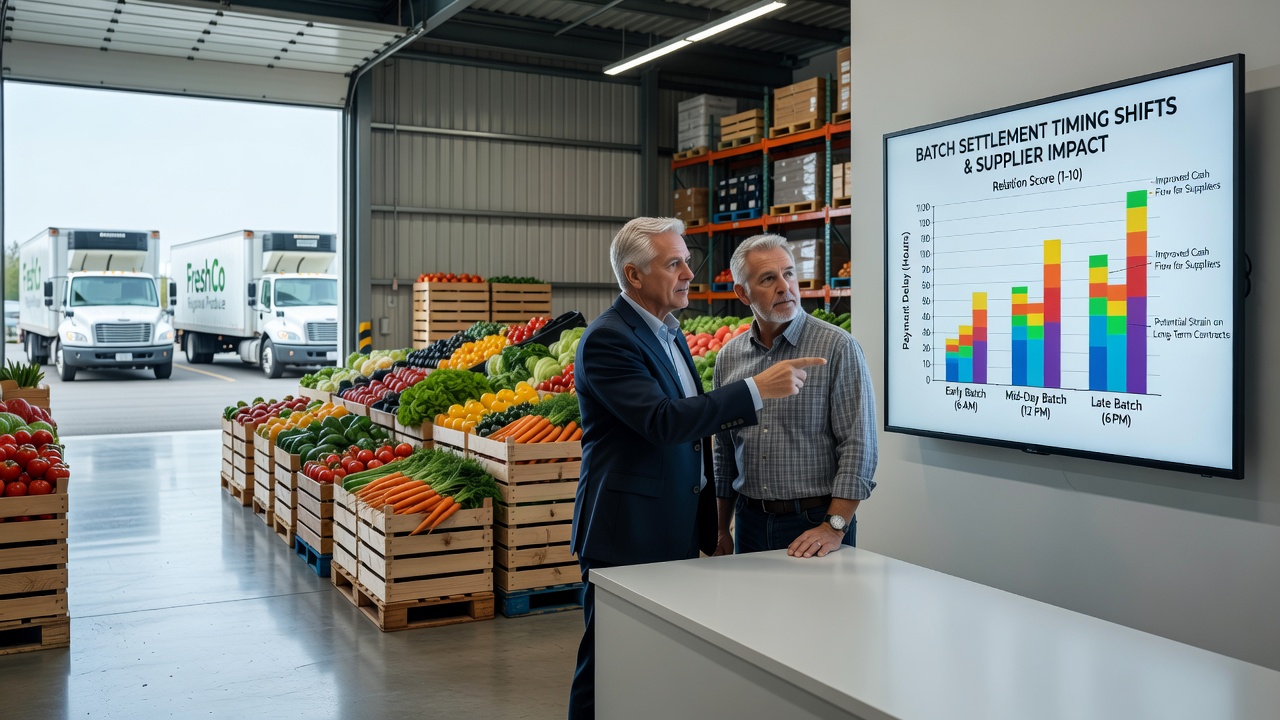
Trust metrics tracked by industry associations show that transparent communication around settlement changes preserves long-term supplier participation, whereas abrupt timing extensions correlate with higher supplier turnover within two seasons. One documented case involved a Midwest distribution network that moved from daily to bi-weekly batches in 2024, after which 19 percent of small-scale vegetable suppliers redirected volumes to competing buyers offering faster reconciliation.
Regional Variations and External Data Influences
Settlement practices differ across geographies because of local banking regulations and processor infrastructure, and European produce networks often operate under SEPA instant settlement options that compress batch windows compared to legacy ACH systems common in parts of the United States. Figures released by Agriculture and Agri-Food Canada reveal that networks adopting hybrid batch models, combining daily micro-batches with weekly full reconciliation, experienced fewer supplier disputes over payment timing in 2025. Similar patterns appear in reports from the Australian Bureau of Agricultural and Resource Economics and Sciences, where timing alignment with seasonal cash needs improved supplier retention across several states.
External factors such as fuel price volatility and weather-driven harvest compression further amplify the impact of settlement timing because suppliers facing sudden cost spikes need faster access to receivables. Processors that provide visibility dashboards showing batch status in real time reduce friction in these scenarios by letting suppliers forecast inflows accurately.
Conclusion
Batch settlement timing shifts continue to shape supplier relations in regional produce distribution chains through direct effects on cash flow predictability, contract structures, and retention rates. Data from multiple agricultural regions demonstrates measurable correlations between settlement intervals and supplier behavior, while contractual safeguards introduced in 2026 reflect ongoing adaptation to processor capabilities. Those adaptations maintain operational continuity across perishable goods networks where timing precision determines both financial stability and delivery reliability.